

Princess Mononoke: How it Subverts Stereotypes and Paves a Way Forward
Spoilers, be warned! I recommend watching the movie first.

San, or Princess Mononoke.
Studio Ghibli
Founded in 1985, this famously renowned animation studio has gone on to produce universally recognized works such as Spirited Away, Howl’s Moving Castle, and My Neighbor Totoro. Some of these movies earned honors, with one example being Spirited Away and its 2003 Academy Award for Best Animated Feature. In total, they earned two Academy Awards, a Golden Globe, BAFTA Award, Golden Bear, three Animage Grand Prix awards, and much more. A couple of their movies are even part of the highest-grossing Japanese feature films that were ever made. Princess Mononoke (1997) was the highest-grossing film in Japan when it was released, breaking numerous box office records. It was only topped by the movie Titanic.
The studio was created by three men: Hayao Miyazaki, Isao Takahata, and Toshio Suzuki. Ghibli is known for their hand-drawn animation, as well as their rich storylines. They dabble in a multitude of genres, from fantasy to coming-of-age. Their films reflect diverse elements of Japanese culture, often manifesting in characters like Totoro or in the environment (like the Kodamas). Throughout their portfolio, there are characteristics that pop up frequently, such as strong female leads or the theme of environmentalism. And in terms of environmentalism, arguably the strongest representative of that idea is Princess Mononoke.
Princess Mononoke
Released in 1997, Princess Mononoke became a cult classic. The movie follows the protagonist, Ashitaka, an Emishi prince. His people were native to Japan during the 7th and 10th centuries, with the film being set during the Muromachi era. This allowed Miyazaki to explore the beginnings of industrialization and its effects on the surrounding environment. We can see that the movie is heavily influenced by Shintoism (particularly animism) and Japanese culture, and its fantastical elements reflect that. Nature is personified, with animal gods and spirits existing. There are two main settings in the film, one being the Iron Works, and the other being the Forest. The Iron Works is home to a settlement of humans, led by the independent Lady Eboshi. In contrast, the Forest is protected by the Shishigami (Deer God or the Forest Spirit), as well as additional beasts like the clan of Muro (wolves), or boars.
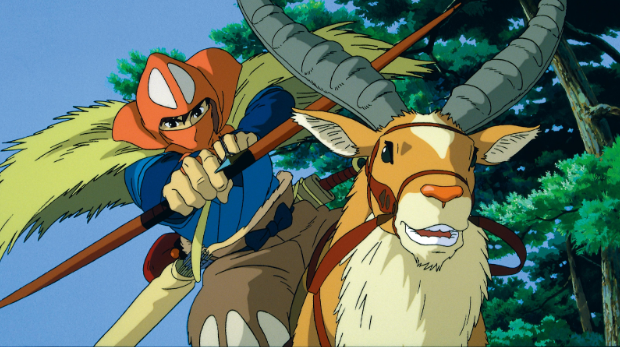
Ashitaka and his elk, Yakul.
In the beginning of the film, Ashitaka kills a boar god (Nago) who had turned into a demon in order to protect his village. As a result, he became cursed and had to leave his home to find a cure. His only clue was that a piece of iron had corrupted Nago from the inside, and it came from the West. When he arrived at the Iron Works, he was initially furious at Lady Eboshi. She was indirectly responsible for his curse, because in order to get more iron to make weapons, she had destroyed Nago’s forest and his kin. It was no wonder that the boar god died with vitriol hatred towards humans, and Ashitaka was appalled that she would commit such a sin. However, when asked by Lady Eboshi about his goal, Ashitaka only replies with, “To see with eyes unclouded by hate.” I think this sentence is best reflective of his character because without fail, he refuses to be controlled by anger. Despite the fact that Eboshi is responsible for his curse (which will kill him slowly), Ashitaka doesn't succumb to his own feelings of fury and bitterness. What I found unique about the movie was how he served more as a mediator, an unconventional role for a male protagonist (or male characters in general). Interestingly, the female characters, like Lady Eboshi and San (the titular Princess Mononoke) are more active and take on traits that are traditionally masculine without trading away their femininity. This is characteristic for Studio Ghibli, as they’ve long been hailed for their depiction of feminism.

Lady Eboshi.
It’s quite easy, when portraying a scenario of industrialization vs. nature, to paint one side as the “bad guys”. In Princess Mononoke, Ghibli avoids treading this path and that can be seen with their characterization of Lady Eboshi. Initially, the fact that she destroyed the home of another being without remorse, or the fact that she makes weapons for the sake of killing these animal spirits, creates a terrible impression. Yet, as we see from the perspective of Ashitaka, she does so in order to protect her people. She takes in women who worked at brothels and lepers and in their words, gives them a purpose. The respect the townspeople have for her is for a reason, and Eboshi is much more than an ordinary antagonist.
On the other hand, San or Princess Mononoke, is part of the Muro clan. Muro is an enormous mountain wolf (also a god), and she is the mother of San and her two wolf siblings. After being abandoned as a child, San grew up in the Forest. Similarly to her wolven family, she shares a deep hatred towards humanity and their encroachment on their home. They have the duty to protect the Deer God’s forest, and San seeks to kill Lady Eboshi. The Iron Works have destroyed and set fires to entire forests, drove out animals, deforested areas, and killed their “people”. Both Lady Eboshi and San want to protect their homes by destroying the other.

San and Eboshi, both trying to kill each other.
At this point, you might be wondering what the Shishigami is going to do. They’re the god of both life (as the Deer God) and death (as the Nightwalker). All the animals and the trees are under their protection, yet the Shishigami has little to no agency as a character. They don’t interfere in the struggle of man versus nature, and they primarily function as a higher being, one whose goals and thoughts are unknown. Yet, the Shishigami is the sole target of the Emperor of Japan, who employs his men and Lady Eboshi to hunt it down. In the belief that it’ll grant him immortality, his orders are to cut the Shishigami’s head off. This is the overarching plot of the narrative.
I think the best parts of the movie is how well they incorporate thematic ideas. There are a lot that can be easily applied to Princess Mononoke, but I will only talk about industrialization vs. nature and the idea of renewal.

The top image is of the Nightwalker (Daidarabotchi) and the bottom is of the Deer God (Shishigami). The two are the personifications of the Forest.
Industrialization vs.Nature
This theme takes on many forms throughout the movie. Whether it’s San vs. Lady Eboshi, the degeneration of the Apes because of the humans, the motive for the boars, it’s present in every minute of the film. Nature wants to destroy humans, and humans want to destroy nature. Simplified, it seems one-dimensional. More nuanced however, is the inclusion behind each of the sides’ motives, and the reason why. This struggle between the two presents how difficult it is to find a balance. There was a specific moment in Princess Mononoke, in which Okkoto, a wise and old boar god, remarks that as human influence grows, the old gods of nature are fading and that his tribe is growing smaller, weaker, and more foolish. His decision to lead a suicidal attack on the humans is because he believes it’s a better fate to die in battle than it is to die as game to be hunted. In general, both sides believe that it is impossible for both nature and mankind to coexist.

Okkoto, a respected boar god who led his tribe to attack the humans in a last attempt.
Renewal
Yet, the movie consistently pushes forward the idea that despite destruction, life still exists. Ashitaka embodies this notion, as throughout the movie he seeks to find a way to reconcile the two warring sides. He’s able to move fluidly through the Iron Works and the Forest as he can understand the plight of both groups. His character pushes against the usual narrative, and is the driving force behind balance. It seems almost impossible for humanity and nature to find a way to coexist, especially after Eboshi kills the Forest Spirit, unleashing death and destruction on the land. The Nightwalker emerges from the headless body of the Deer Spirit, and spreads death as it searches for its head. Kodomas, signs of a healthy forest, die by the masses as they fall from the trees. For San, it signifies the complete and utter desolation of her home, something that she had so ardently fought against. Although Eboshi achieved her goals, she had also kickstarted the destruction of her own home, as the Nightwalker spared no one.
In a moment of poetic revenge, the head of Muro (she died to save San) bites off Eboshi’s arm, proving that a wolf’s head “still has the power to bite”. In this scenario, is it possible to put aside hatred and anger to find a way to live?

The Nightwalker emerges and kills all life around it, as seen by the falling Kodamas.
Ashitaka believes so, and he still saves Eboshi. He goes on to convince San that there’s still a way for them to stop the annihilation, and that they can’t give up. At the climax of the movie, Ashitaka and San return the Deer God’s head to the Nightwalker, as Ashitaka adamantly argues that “human hands must return it” since it was humans who beheaded the Deer God. The Nightwalker retrieves its head however it disappears in the rising sun, missing its chance to transform. Through the Shishigami’s death, the slew of sludge and destruction quickly disappeared under the onslaught of life growing back, as plants and greenery covered the devastated Iron Works, and the Forest was reborn.

Life comes back.
Yet renewal doesn’t only come in the form of nature. The scene cuts to Eboshi with the townsfolk around her, and she tells them “We can grow a good village here.” In the face of this crisis, in which they lost everything, the people of the Iron Works resolve to start again. Not as destructive agents, but as humans with the ability to coexist. As a character, Eboshi displays growth, as the former hatred she had towards the Muro Clan is now shaken; she was carried to safety by one of San’s brothers, the very beings she sought to kill. She has seen how her people rallied together in order to live, and she herself had realized that value as well. In a sort of a redemptive arc, Eboshi is now looking to repair instead of to kill. The same goes for the townsfolk, who have seen the Forest gods as beasts and monsters before. When the Shishigami dies (and subsequently creates regrowth), one of the men remarks, “I didn’t know he made flowers bloom.”

The people of the Iron Works after the aftermath.
As for San, she doesn’t recognize the regrown Forest as her former home. It’s not the Deer God’s Forest that she knew, and she says so to Ashitaka. The humans did kill the Shishigami, however Ashitaka tells San that the Deer God can’t die because “He is life itself.” Even so, San cannot bring herself to forgive humanity, and decides to continue living in the forest. Ashitaka says he’ll live with the townsfolk and help them repair, and together, he and San can find a way to live. As always, Ashitaka continues to strive for coexistence, and even though we were given no definite answer, the ending of Princess Mononoke is hopeful. We can hope that they’re able to find a way to survive, and that they can learn to live side-by-side. We can hope that instead of fighting each other, humankind and nature can help each other. It also helps that the last scene is of a Kodoma, the symbol of a healthy forest.

Ashitaka and San go their separate ways.
So?
Besides Princess Mononoke having a strong and compelling storyline fitted with vibrant animation, you might wonder: why is it so significant? Why is a movie worth diving into? What purpose is there? All pieces of media, whether it be games, articles, or movies, have an agenda. Whether or not the intent behind the work is to make people laugh or to disperse a greater message, movies in general undoubtedly have an impact upon people. They can shape entire childhoods and what’s more impressionable than an elementary school kid? Today, we face a climate crisis that has already led to the extinction of hundreds of species and the destruction of habitats across the world. Unfortunately, much of it was facilitated by our actions. It’s never been more crucial to make steps towards change than now, but there are others who believe that it’s too late to even try. Princess Mononoke shares ideas that can be incorporated into our current approach to climate change, such as the idea of relationality or coexistence. I think in particular, its message of hope is something that we can use today. There is nothing more important than instilling hope into future generations, in order to inspire change.
SOURCES:


Comments