


A Brief Guide on Language Learning
- Aayan Muhammad Zahidi
- May 2
- 14 min read
How to learn a language: for those who have no idea what they are doing.

Preface
Languages are the means through which us humans communicate, and without it, society as we know it would cease to exist. We are all born with a native language, sometimes even multiple; however, it is an incredibly difficult task to learn a language, especially one that is completely unrelated to one’s own. As such, I shall give some useful advice regarding learning languages, drawing on my own experience learning Russian, Mandarin, and Japanese, as well as sharing some ideas from the work of Steve Kaufmann, a renowned polyglot and author.
Prerequisites to Learning a Language
In order to successfully learn a language, one must have the will-power to continue studying no matter what. If pulled off successfully, one can quickly learn an enormous amount of information with excellent retention; yet, if one is not consistent with learning, then it will take many years of continually bursts of motivation and sloth. It is better to learn a little every day than to learn a lot on Sundays and forget the rest of the week. As such, if one wishes to learn a language, or multiple, even, then you must have a strict work ethic. Better yet, if one is not already present, then the study of language could be the start of a brand new one.
Second, one must acknowledge that it will take a long time to learn a language, and the learning curve is exponential. It takes about two weeks to learn 1,000 words in Japanese, and another month to get to the first 2,000, yet it may take another six months to come to a total of 5,000 words. Vocabulary is merely one lane on the course that is the learning of a language, but one can clearly see how it takes a long while to learn a great deal of things. Progress may seem fast at first, but before rushing to claim new words for your cerebral empire, you must ensure compliance amongst those already conquered, that is to say, you must review! So beware, then, of the feeling of progress and novelty at first, and how it may lure you into its trap of time.

Finally, why is it that you want to learn a language? To reconnect with one’s culture, to explore a new one, to advance one’s career, or just for the sake of doing something? The reasoning behind learning a language is just as important as the methods by which such language is learnt, for if there is no purpose, no goal, there is no will. Would you like to boast to friends, family, and everyone else that you know another language that is of your native tongue? That is a reason too. It matters not if your reasons are humble, for as long as there is one you will be all-right. Thus, identify why you want to learn the language of your choosing, and it will be the foundational force for the continuation of your studies. Always think back to it when feelings of regret eventually befall you.
To Begin
Motivation
Time is of the essence. Think back on how much time you have spent today doing things that you now regret. Watched the telly for too long a while? Sat and indulged in excessive online ventures? Then, think of what could have been done, had you spent that time a little more wisely. It may be slightly rude, insulting even, to say this, but stop wasting your time! Success does not fall into one’s idle hands from sitting around doing nothing. Sleep well, eat well, and stay healthy. Eat your vegetables and the lot. Keeping a healthy mental disposition will aid you in your quest for semantic acquisition.

Resources
Beginner resources are usually quite prevalent, but lack in quality. Duolingo, for instance, is well known amongst all language learners, and most people with an internet connection. However, simply put, Duolingo is terrible. Along with the recent AI controversy surrounding the company, the actual content is severely lacking in grammar and explanation, and does little to actually “teach” you anything. Do not use Duolingo unless you want to build a habit from which you can extend your actual studying from. Its gamification is a useful thing indeed, but there are other ways to get started. At least Duolingo is an easy one to get started with, and is fairly enjoyable.
In order to successfully begin your language learning journey, you must choose a reliable, comprehensive source of information. Textbooks and online courses are great to get started with, and will kickstart your studying, giving you a guided path and a visible goal. Purchasing a beginner textbook in the language of your choice, or downloading a PDF online, is ample for your first fifty or so hours of study. Following the material will get you most of the way there, and your own strength and consistency will push you over the finish line.

Action
With whatever language one is learning, the script should be the first priority. The script, as in, the writing system of the language. Download a chart online, practice pronouncing the glyphs, and ensure that you have at least a basic understanding of the writing system of your language. I highly recommend learning the IPA, that is, the International Phonetic Alphabet, as it will help you with pronunciation significantly, and will further assist you if you wish to delve deeper into linguistics. For some languages, like Mandarin, Thai, or Japanese, it is better to learn how to pronounce each word as you go due to the nature of the scripts of such languages, inconsistencies with “spelling” in such, and the presence of tones. Decide how your target language needs to be approached in regards to this.

I highly advise you look into the installation of Anki on either your computer or mobile device. Anki is a spaced-repetition based flashcard software which helps you to remember things with supreme retention. For a detailed summary of Anki and how it works, see this well-made article. I will also briefly explain how to use Anki in this guide and under these circumstances, located at the end of the article. Anki will be your go-to method for memorising vast amounts of raw data, such as vocabulary, grammar rules, and even comprehension practice. Create cards from your chosen material as you progress, and do the cards every day. Do not think of Anki as studying. Instead, think of it as an activity to do throughout the day. If one has any idle time, say, queuing in a line, or riding the bus, then you can practice on Anki and quickly get things done. Skipping a day is non-negotiable. Alternatively, one could download a pre-made Anki deck, which is only recommended if you ensure that the pre-made deck is accurate, and if you do not have any other reliable material. Keep following that format, and eventually you will finish the material. After this, we proceed to the next step.
Intermediate Stage
Now that you have progressed to a level in the language where you can no longer learn from your books and pen, we continue to the next stage. Before you start the next step, however, you must understand at least 80% of the words in a piece of text in the target language, although 90% is recommended. Once you have confirmed this, you may begin. If that is not the case, continue using a textbook or some other guided method, for the next step may be too overwhelming if you do not properly ensure your proficiency.
Sentence Mining
To start, consume media in your target language. Whatever it may be, whether you enjoy it or not, though preferably the former, read and listen. For every word, grammar point, conjugation, or meaning in a sentence that you do not understand, write it down for later. After finishing your session, search up the English definitions of all of the meanings of the words that you have written down, and make Anki cards for them in order to memorise them.

This is why one must accurately ascertain a level of about 80% comprehension before starting this phase, for one would have to log almost a fifth of any sentence, which can get tiring fast, dissuading you from pursuing your goals. It is essential that you use Anki for this, as it is the most efficient way to retain knowledge in this manner. You do not have to do this with every single sentence you encounter, but this process will be expedited if you do. Eventually, after many hours of sentence mining and memorisation, one would be able to understand 95-98% of the target language. Yet, understanding sentences is not the only thing needed to become conversational in a language.
Cloze-Deletion and Writing
One must not only understand, but formulate sentences in other languages; yet, this step is often neglected in favour of more rapid “learning”. Do not be fooled by short-term satisfaction of understanding quickly. Whilst doing your comprehension Anki cards, use the “cloze-deletion” card type on Anki, and procure a sentence in your target language, either from exposure or from a textbook.
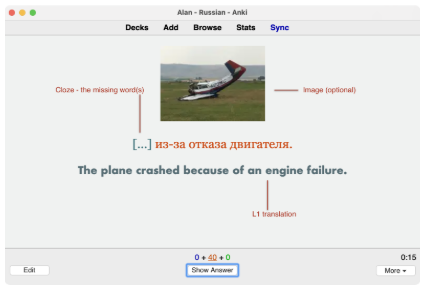
Then, cut out one word or phrase, and make its very absence a new thing to study. In this way, one may be able to not only fill in the blanks with context in rapid speech, but also develop their natural understanding of the underlying grammatical and phrasal structures, which is essential if one wants to sound like a native speaker, or at least if one wishes to gain a good command of such language.
It is also imperative that one drills themselves with sentence translation exercises on a consistent basis, for it will enable expedited speaking and writing skills in the future, and train one for fast-paced situations in their target language, wherein thinking for a few seconds or more is a luxury. It also aids in the internalisation of frequently-used sentence templates, in which one can simply substitute the necessary words — incredibly useful for those that wish to achieve a conversational level of fluency in minimal time.
Comprehension, Listening, and Tests
Be sure to test your capabilities frequently, as if one is truly progressing through the language, then it would be evinced via one’s practice test score, and such would likely foster a feeling of encouragement and advancement, motivating one further, and setting one straight on the path to fluency. Now, there are not a few ways to measure linguistic aptitude, and I shall go over a small scraping’s worth of them, but do not limit yourself to these presented here; go forth and discover new methods of measuring one’s worth, as whichever one provides the best insight for your purposes is the perfect one for you, and as such, I cannot provide a perfect prescription.

Indeed, take my words only as a starting point, and if possible, expand upon it from there. If my advice works well for you, that is a great thing, and it is alright; however, it may not, so do be prepared to conjure up a plan from your own creativity.
As for the tests themselves, one should look to the main institution that governs foreign language learners of one’s target language. For instance, Japanese proficiency is typically certified by the JLPT, and standard Chinese by the HSK. Look for mock tests online, official or otherwise, and ascertain whether you have underestimated or overestimated your capabilities, as well as reviewing, of course. Do this continually throughout your journey, on a regular, scheduled basis, in order to have some goal to look towards when studying. Indeed, by structuring it as a school’s exam would be, one is more likely to work diligently and with great effort. The lack of a defined structure is fatal for one’s journey, so be sure to prioritise such.
Then, one should practice listening and comprehension. An important aspect of such is seeking out comprehensible input, which is content in one’s target language that is just above one’s current level of proficiency. It is important to not delve right into native level content, as it is impossible to understand something of which more than fifty, even twenty percent cannot be understood. Aim for one or two unknown words or phrases per sentence. With more unknown words comes higher difficulty, but also more efficient learning in regards to time up to a certain point.
Social Interaction
Whilst it is certainly feasible to learn a language completely from the comfort of one’s home, and be understandable and fluent, social interaction will inevitably play a key part in the acquisition of the target language. What, you think you can simply learn Japanese by watching anime all day? Forgive me for my terrible utterances, but go outside, and touch grass!

Altercations aside, talking to real, human people, if that is something possible, will absolutely grant a great boon to your studies. The way people speak on the telly, on the radio, and even in educational content is not how the average person speaks. That is to say, you won’t hear politicians say “yo” (besides Bush), and it is very strange and unusual to speak as if one is always the narrator of a dystopian fiction. Talking to real, human people will ensure a more native-like cadence to one’s speech. Make sure to diversify your media too! Homogeneity is beneficial for building states, not for building linguistic intuitions.
Final Stage
After consolidating many words, definitions, grammar points, and whatever other unique features a specific language has to offer, one will inevitably reach a point of incredibly diminishing returns. After around 10,000 to 15,000 words, one would reach the level of a young child in their respective language, about six to eight years old. If one has come this far, do celebrate! It must have been a hard journey, and although one has indeed come so far, there is still much to learn and much to do.
Native Input
After reaching this level of fluency, gone will be the days of comprehensible input, worrying about every single sentence, and every single word. Pick up a book, a TV show, a radio podcast, or any other sort of media. One does not need to view themselves in the eyes of a learner now. Instead, imagine oneself as a little one, back in school, and more excited to learn than ever (albeit that may not be the case for most children). Read something old, and by old I mean borderline archaic.

Just as those taking English class in school might study Shakespeare, go forth and read The Analects, or Don Quixote! If you have come this far to learn a language, it would be beneficial to read things of cultural relevance. You are no longer a language learner, but a literature student. Progressing more in the language is quite optional now, and one could easily survive in their target language’s country, save for the fact that they might need to learn work-related jargon. The only reason to continue learning would be for the love of the spoken and written word, which is an honourable reason nonetheless.
Now, to choose things to consume may be a difficult task for some, and is out of the scope of learning languages in the sense described until now. That being said, a word of advice when choosing works to consume: do make sure that it is enjoyable to oneself, and not being consumed merely for the purpose of its popularity or significance to culture. Personal fulfillment overrides any other requirement.
Anki Guide
Overview
I have mentioned Anki many times in this article, and it would not be in the best interest of the reader to be forced and dragged through a half-hearted explanation, and so I have given it its own section. Anki is an SRS application that aids with specific memorisation, and is quite popular amongst language learning communities. First, let me explain the advantages of using Anki and its SRS system.

What is SRS in Regards to Anki?
SRS stands for spaced-repetition system. You may know that reviewing things time after time again causes one to remember them for longer periods of such. Spaced-repetition takes advantage of that; what it does is simple, it displays the information for review right before you are predicted to forget it, or before it reaches a certain percentage of that calculated value, ensuring that it is never forgotten to some degree as long as the review is done every day. For each individual piece of information, a different forgetting curve is calculated based on pre;vious data using the algorithm, so there is little to no wasted time.
Advantages of Using SRS in Anki
As previously mentioned, Anki uses an SRS. One may wonder what the advantages of using an SRS would be, which is quite self-explanatory. Compared to other methods, like rote memorisation, unscheduled flashcards, and self-testing, SRS algorithms are proved to be more efficient, with many studies showing such.

For instance, a study by The Department of Education in 2020 showed that students who utilised an SRS in their studies reported higher average grades; it collected data demonstrating how SRS continued to be beneficial for long-term memory — an important factor to consider when acquiring new vocabulary for a language. Obviously it is not ideal for one to memorise thousands of words, only to completely forget them a few months later.
Whilst there are other softwares that employ SRSs, they are either not as well-developed as Anki, or require a fee to use, like SuperMemo — widely considered to boast a somewhat-superior algorithm, and unfortunately costs $9.90 a month. Anki also has the advantage of being open-source, so modifications can be easily made by the community, and the application can become highly customisable. Most additional desired functionalities can be installed and loaded from shared addons on the website page or the application page.
Setup and Initialisation
Take heed! This information is most certainly of great importance. If you only have access to an iOS device, Anki will cost a hefty sum of $24.99. If this is the case, seek a computer to create an account and import necessary information, for the web version of this application is limited in functionality. Android users may breathe with ease, for it is completely free (AnkiDroid). To set up, it would be best to install such on one’s personal computer, although it can work just fine solely on a mobile device. If one is not confident in their abilities to correctly follow the process of initialisation described below, I would recommend watching a tutorial on how to do such via a website such as YouTube for your convenience.
After installation, decide whether you would rather make your own flashcards from an existing source, like a textbook, or if you would rather download a pre-existing deck. Pre-existing decks act as foundational sources for vocabulary and grammar points, and they can be used in lieu of textbooks effectively. If one prefers that instant extraction of information, then download a good deck for one’s language of choice, import it, and get started immediately. The application’s interface is very intuitive, so basic usage need not be explained unless more intimate knowledge and greater efficiency is required. If one would rather make their own flashcards from an external source, one only need press the plus icon in the bottom right corner, create a deck, and add cards to the deck with one’s desired information to memorise filled in the specified boxes. For each piece of information a new card is made.
Usage of Anki
To use Anki is quite a simple thing indeed, in fact, one could do it mindlessly from bed and still retain the information regardless due to the very nature of the algorithm. Anki works by showing you the piece of information and forcing you to recall it. A successful recall permits you to press the buttons “Easy” for an almost instant recall, “Good”, for a fair recall, and “Hard”, for a recall that might have taken ten or so seconds to fully remember.

If one fails to remember the material, then the “Again” button is used. It is important to stay consistent when clicking these buttons, as the algorithm will use the data from such pressed to calibrate its personalised algorithm for each card. It is imperative not to cheat the system and declare that you remembered something when you did not, as it only serves to hurt your own prospects. Continue to use Anki, and you will be able to memorise vast quantities of information in relation to language learning.
Regards
Thank you for reading this brief guide on language learning. If any questions are brewing in the mind of the reader, I urge the writing of a comment beneath this article, and I will do my best to respond to them as soon as possible and with great accuracy. If the idea of learning languages really intrigues you, then I recommend reading the works of Steve Kauffman, a well-known polyglot and a celebrity amongst language learners. Learning a language is tough, so let the forces of fate guide thee on the path of knowledge.
SOURCES:
The Linguist: A Personal Guide to Language Learning by Steve Kauffman, 2003
IMAGE LINKS IN ORDER:
https://www.dreamstime.com/illustration/speech-bubble-welcome-different-languages.html
https://medium.com/chaddis-chatter/textbooks-alone-are-bad-for-us-heres-why-4c1f211500c0
https://www.freepik.com/premium-vector/job-exam-test-vector-illustration_6309172.htm
https://blogs.baylor.edu/artsandsciences/2015/12/11/on-don-quixote/


Comments